A Sandbox for Cyber Threats
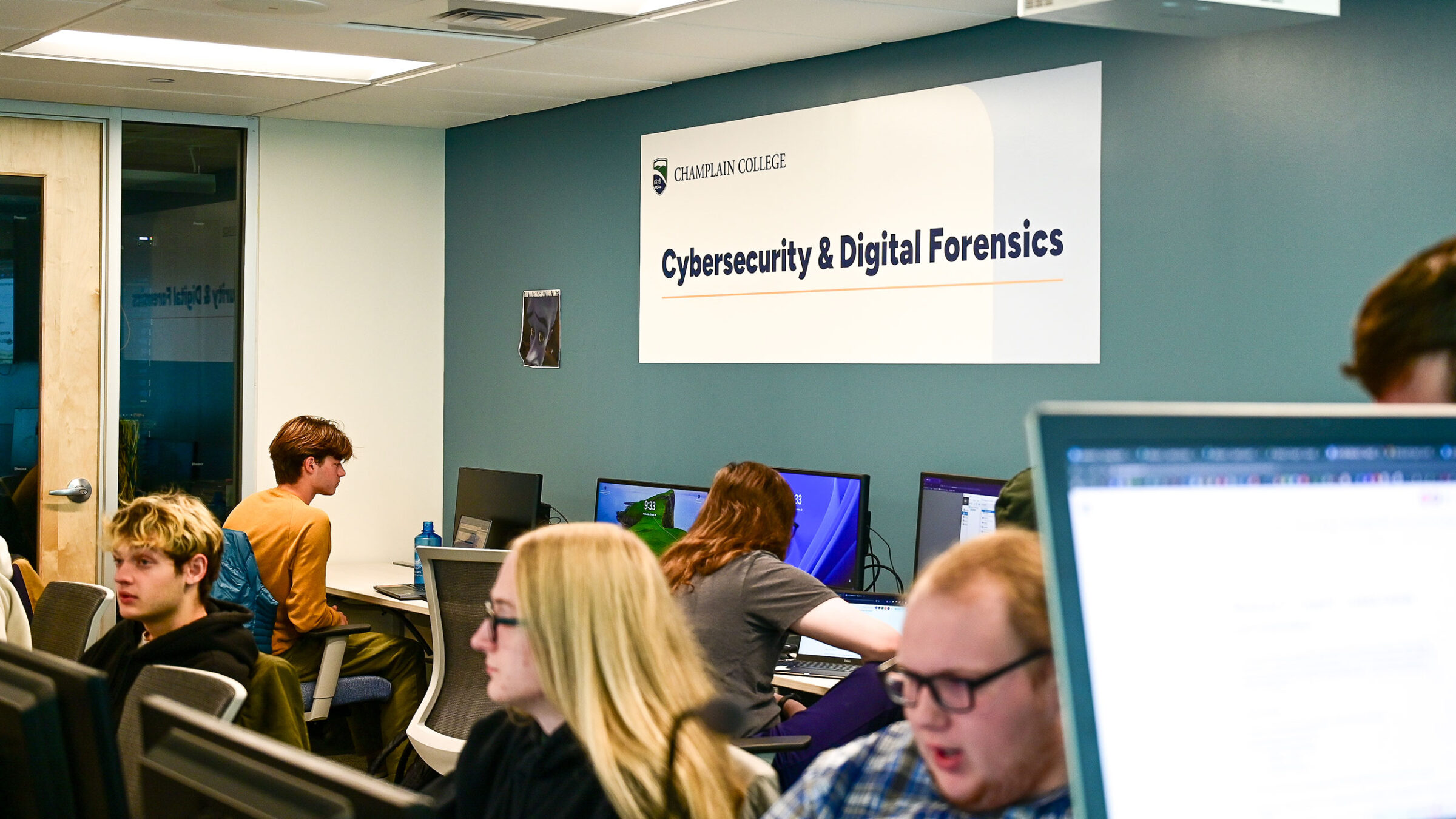
Running cybersecurity labs or threat simulations on your personal computer has many downsides. Not only is it limited by your computer’s hardware restrictions, but it also leaves you vulnerable to security incidents like a data breach, ransomware attack, or malicious software. Without the proper protection, there’s no guarantee in place to ensure your sensitive information is safe. Cyber ranges are a critical infrastructure to alleviate those cyber threats while allowing users to create flexible environments within a series of networks for digital forensics and cybersecurity work—separate from any personal computer.
At Champlain, cyber ranges are an integral aspect of the Computer Networking & Cybersecurity and Digital Forensics programs. Our rich history surrounding these network environments provides students with many opportunities to work directly on and in these networks. In fact, students can even make their own!
What is a cyber range?
A cyber range is a series of networks that allow organizations and users to practice cybersecurity and digital forensics tools. It acts as a containment tank; any viruses or security risks you create on the cyber range can’t create any vulnerabilities on your network. Think of it as a sandbox: you can play with and mold the sand as you please, but the walls make sure nothing spills out onto the grass. Imagine, then, putting several sandboxes next to each other. These represent the multiple testing environments interconnected within a cyber range.
Cyber ranges also make cybersecurity work more accessible and add a layer of flexibility. You don’t need an advanced computer to access these ranges, and once inside the range, you can simulate any kind of computer.
Hands-on Learning Meets Professional Impact
Champlain’s history of cyber ranges started with a previous faculty member, Devin Payton, who aimed to build centralized hands-on lab environments where students could work on tech-related classwork without hosting on their local devices. Payton first made one server in Skiff Hall that allowed students to connect with their browsers and access lab environments. Since then, that server has grown to over 15 servers now hosted at the Miller Center on Champlain’s Lakeside Campus. Today, these servers support thousands of virtual machines (AKA sandboxes), and are now known as Champlain’s “cyber.local” environment.
Champlain stands out due to our deep understanding of these systems. Ryan Gillen, a cybersecurity adjunct faculty member and manager of the Leahy Center for Cybersecurity & Digital Forensics, emphasizes the importance of these systems: “I think what helps set Champlain apart from other programs [is] that [they] don’t necessarily have their own custom cyber ranges. Building that up over the last many years has really left us with a cultural knowledge within the Champlain community of being well versed in building these types of environments.”
Set in our newly renovated Freeman Building, Champlain students can take advantage of the new server rack, and even get to play in their own sandboxes. But first, they have to build them. In Network Security Controls, a 300-level course, students create their own mini cyber range, hosted directly on campus.
There are opportunities to pursue these skills further during a 400-level course, Advanced Topics in Systems Administration & IT Infrastructure. Students in this class focus on adding a layer of automation to these networks, allowing for deeper look into how professionals create bigger network environments through large-scale deployment strategies.
“A lot of the time in the industry, unless you’re working for a really small mom-and-pop operation, you may be working in an operation where you’re going to be dealing with heavily scaled environments where nothing is done manually. Having those concepts of automation and scaling are important,” Gillen stated.
Champlain students’ exposure to creating and working with these cyber range environments sets up young professionals with the skills they need to succeed within the field. By taking these hands-on courses and getting involved, students will not only learn to prevent cyber threats, they’ll learn to work within a critical cyber environment and create their own.
Looking for more information about Champlain College? Start here!
Fill out the form to receive helpful information!
Author


More Inside The View
Ideas
From the minds of our students, faculty, and alumni.
News
The latest from Champlain College.
People
Champlain is more than just a place; it's a community.
Places
On campus, in Burlington, and beyond.
Events
Check out our many campus events and get involved! Refine your search by using the filters or monthly view options.