Imagine being able to begin your career before you get your high school diploma. For students who take part in the Cyber Start program, that dream is a reality. They take college-level classes in their junior and senior year of high school, and leave with both cybersecurity knowledge and a head start in their major. In recognition of Cybersecurity Awareness Month, let’s dive in.
What is Cyber Start?
Cyber Start is an online dual-enrollment program developed by Champlain College in partnership with nuHarbor, a Vermont-based cybersecurity firm with office space at our Lakeside campus. High school students can enroll in college-level courses taught by Champlain College’s industry-expert faculty. nuHarbor provides opportunities to apply what you learn in practical, industry-relevant scenarios.
Whether you’ve taken cybersecurity classes before or you’re just a problem-solver who’s passionate about helping others through technology, Cyber Start can give you the foundation required to get a leg up in both the industry and your college career.
Students enrolled can take up to three undergraduate courses, earn nine transferable credits, and earn conditional acceptance to Champlain College. Students who successfully complete all courses earn an undergraduate certificate in Cybersecurity.
“By the time these students sit in a college classroom, they’re not starting from zero. They’ve already touched the tools, already wrestled with the vocabulary, already thought through adversarial scenarios,” shared Assistant Professor LaKysha Patnode. “That means we can go deeper, faster, instead of spending weeks on the basics. And for students who stick with the program, there’s an internship path waiting for them too, where they get to apply what they’ve learned in a professional setting.”

How Cyber Start Students Get Ahead
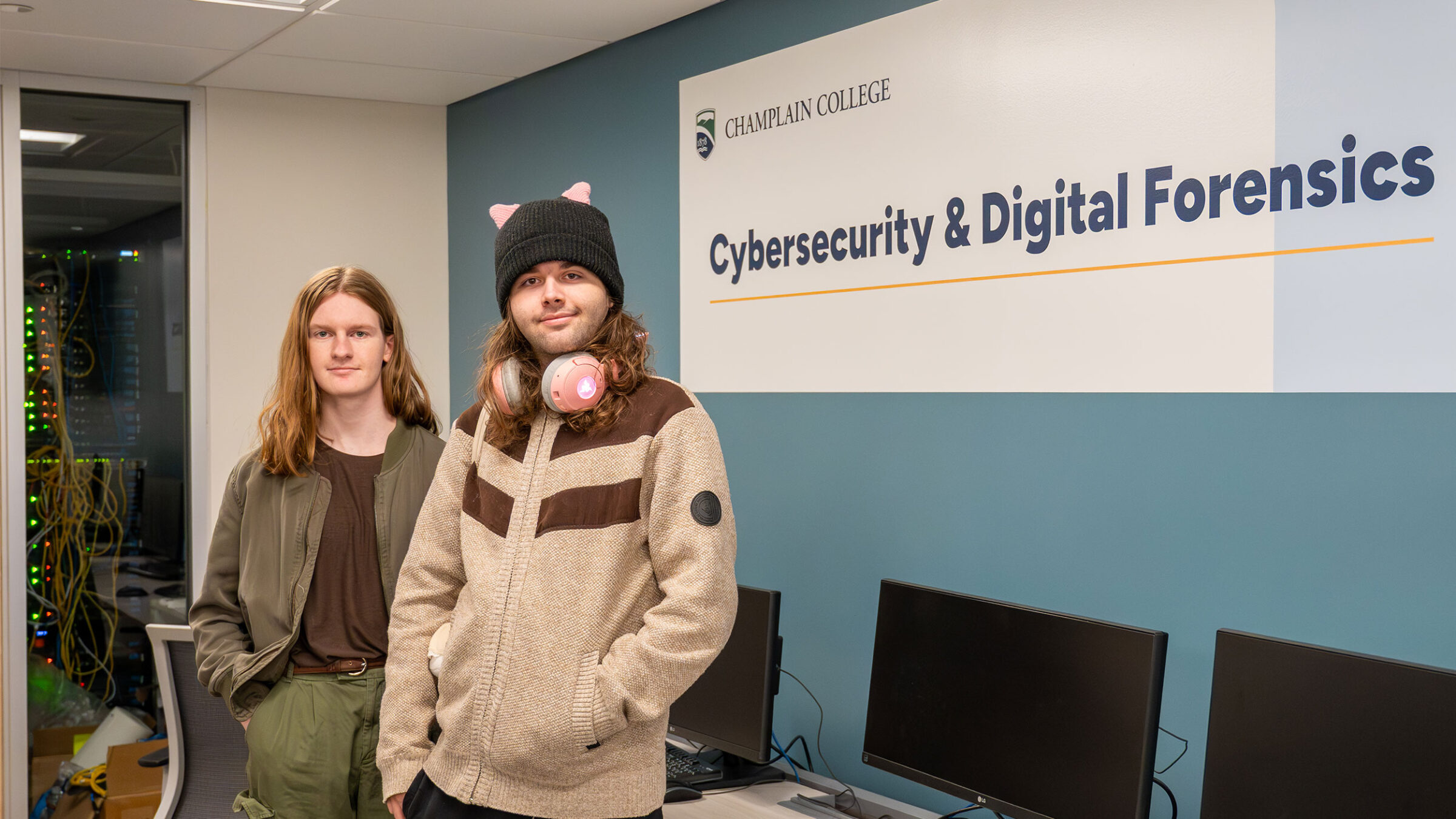
Digital Forensics major Logan Wendell ‘28 took Cyber Start classes during his senior year of high school after his criminal justice teacher recommended it. “It immediately piqued my interest, because it sounded like the perfect opportunity,” he said.
Now at Champlain, he’s blending his cybersecurity and criminal justice knowledge to tackle class projects and assignments with ease.
“I knew what to expect, and I was able to get into the material a lot quicker,” Wendell explained. “All the terminology and information that was needed for the courses was useful to have in my backlog to understand the work a lot better.”
Beyond classes, Wendell is jumping headfirst into the Champlain community. He is a member of the Champlayer’s theater club and the Improv troupe: Los Dormant Volcanoes.
“I have made such good connections here that will, I guarantee, last years beyond my graduation,” Wendell stated.
Computer Networking & Cybersecurity major Lucille Paxton ‘30 also took Cyber Start classes beginning her junior year of high school in Essex Junction as part of the vocational curriculum.
“[Cyber Start] solidified Champlain as the school that I wanted to go to. I was able to visit the Leahy Center, and I understood that Champlain is very invested in this major,” Paxton reflected.
Paxton earned all nine college credits and the undergraduate certificate in cybersecurity. Plus, she got a peek into how college courses work overall. “It’s been quite helpful to have a better understanding of how college course material is going to work,” Paxton said.
“If you’re interested in cybersecurity or Champlain at all, it’s a great program,” Wendell added.

Why Cybersecurity Matters
According to Microsoft’s 2024 Digital Defense Report, there are 600 million cyberattacks per day worldwide. This number is only getting higher. With developments in Artificial Intelligence (AI), there has been an 89% increase in attacks by AI-enabled adversaries.
It’s clear: we need cybersecurity professionals, and companies are recognizing that, too. The U.S. Bureau of Labor projects 29% growth for information security analysts (or cybersecurity professionals) from 2024 to 2034. That is seven times the economy-wide rate.
We asked Patnode why getting started early in the cybersecurity industry matters. She provided notable research and statistics showing the importance of a cybersecurity education.
“The global workforce gap is sitting at around four million unfilled positions, according to ISC2’s 2024 Cybersecurity Workforce Study,” says Patnode. “A 2026 survey from the Information Systems Security Association and research firm Omdia found that 75% of security professionals said a skills shortage had affected their organization, with nearly a quarter calling the impact significant.”
According to Patnode, ransomware and AI-driven attacks continue to evolve at a rapid pace, making it increasingly important for students to develop strong cybersecurity fundamentals. Programs like CyberStart help equip the next generation with the knowledge and critical thinking skills needed to adapt to an ever-changing threat landscape.

Interested in learning more about Champlain?
Fill out the form!
Author