Is Cybersecurity a Good Career?
To protect organizations across all industries from the threat of cyberattacks and ever-complex risks, advanced cybersecurity strategies are non-negotiable in our digital-first era. If you are interested in pursuing an evolving, tech-driven role that’s poised to become increasingly relevant in the years to come, you may be wondering: Is cybersecurity a good career?
The following guide outlines 12 compelling reasons to pursue a cybersecurity career, plus the importance of earning a bachelor’s degree in computer networking and cybersecurity.
12 Reasons to Work in Cybersecurity

What is Cybersecurity?
Cybersecurity is an advanced technical industry focused on the protection of computer systems, networks, and data from unauthorized access or attacks. According to the Cybersecurity & Infrastructure Security Agency (CISA), the field is anchored by the CIA’s best industry practices, known as triad: confidentiality, integrity, and availability of information.
Cybersecurity professionals work to implement cyberstrategies that protect data and ensure the safe flow of information through computer networking systems. They’re essential for managing modern infrastructure, including emerging technologies, cloud computing, and the Internet of Things (IoT) networks. Practical applications of cybersecurity include encryption, ethical hacking, risk assessments, and incident response, allowing cybersecurity professionals to specialize in key areas that interest them most.
Cybersecurity Case Studies: How Information Security Analysts Navigated the Most Well-Known Data Breaches
Many organizations today would cite data breaches as one of their most pressing security concerns, considering that cyberattacks can be debilitating to their operations. The risks of cybersecurity attacks are significant: personal data can be exposed, company operations can be disrupted or halted, and brand reputation can be compromised.
For cybersecurity professionals, preventing these attacks is paramount. The most notable attacks have had startling impacts on society, and the risk of more subversive and invasive attacks increases with each passing day.
Take the Microsoft Exchange Server data breach in early 2021, for instance. More than 30,000 United States businesses were affected by this high-level, far-reaching breach, in which hackers gained unauthorized access to email accounts. Everyone, from small business owners to high-ranking government officials, was exposed. Cybersecurity experts stepped in immediately, providing multi-layered support to detect and contain the attack; yet this still underscored the need for improved cybersecurity practices.




Why Is Cybersecurity a Good Career Choice?
With all of this in mind, these are just a few of the reasons to consider a career in cybersecurity:
- There is a high demand for professionals with cyber skills.
- Cybersecurity measures are essential to every industry.
- This career path offers future-proof job security.
- Cybersecurity positions reflect a high earning potential.
- There is continuous innovation in the field—you’ll never stop learning as new threats and technologies evolve.
Choosing Your Program: Why You Should Earn Your Cybersecurity Degree at Champlain College
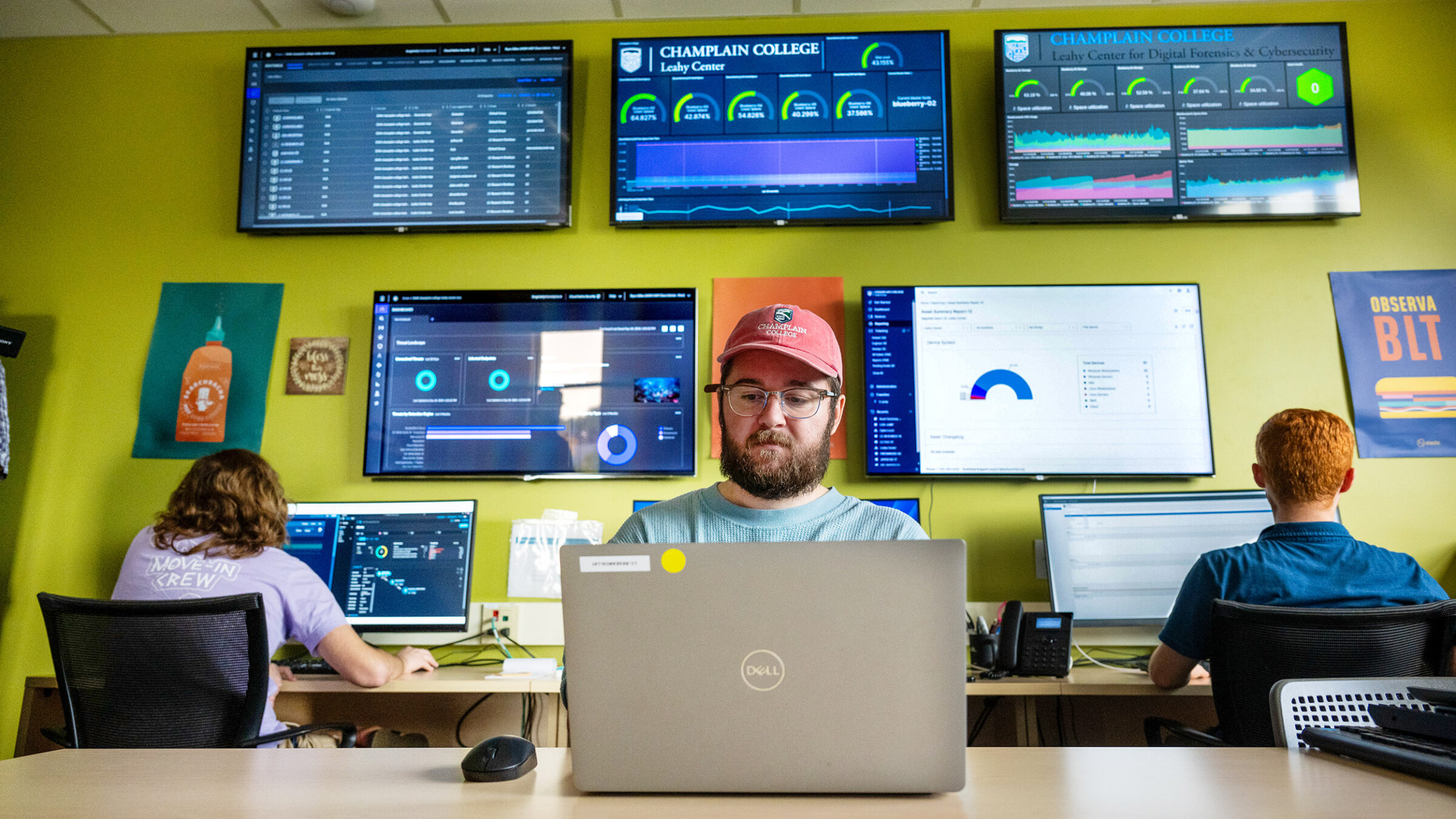
At Champlain College, students who enroll in the computer networking and cybersecurity degree program gain access to advanced facilities that support their learning experience and outcomes. The Leahy Center for Digital Forensics & Cybersecurity is a world-class learning lab that allows students to work with state-of-the-art technology as they develop critical cybersecurity skills in real-time.
Undergraduate students can take advantage of the Leahy Center for Digital Forensics & Cybersecurity to:
- Provide personalized cybersecurity support to a wide range of organizations
- Engage in cybersecurity research
- Offer digital forensics and cybersecurity training to local businesses
- Gain real-world experience through paid positions while enrolled in classes
Trusted by the Department of Defense, Department of Justice, the U.S. Secret Service, and a host of Vermont small businesses, the Leahy Center has become the hub of our undergraduate cybersecurity and digital forensics programs, giving students the chance to hone the practical, technical, and soft skills required for this fast-changing field. As one of the few National Security Agency (NSA)-designated colleges for cybersecurity, Champlain College is an optimal choice for your education.
In Their Own Words: What’s It Like to Work in Cyber?
12 Reasons You Should Consider a Career in Cybersecurity
As you evaluate your personal interests and skill set, there are a range of benefits to pursuing a cybersecurity career:
1. Explosive Demand and Job Growth
The strong job growth potential in this field makes it particularly appealing for ambitious professionals who want to enter industries where they can apply their skills and expand their careers. According to the U.S. Bureau of Labor Statistics (BLS), employment levels for information security professionals are expected to rise by approximately 29% between 2024 and 2034, which is much faster than average compared to all other occupations.
2. Job Security That Resists Outsourcing and Automation
Professionals in the cybersecurity field don’t need to worry about competing with automation and artificial intelligence (AI), but instead can focus on leveraging these rapidly advancing tools into their workflows. The work completed by cybersecurity professionals requires creative problem-solving and ethical judgment-based thinking due to sensitivity and trust factors that technology cannot replicate, showcasing the necessity for human expertise over machine learning (ML) technologies.
3. Competitive Salary and Financial Upside
High earning potential makes this field an enticing option for professionals. The solid pay for entry-level positions allows individuals to begin their careers with a strong foundation with eventual six-figure potential for advanced roles in the industry. The BLS reports a median annual salary for information security professionals of about $125,000, while the highest earners in the field earn about $186,000 per year.
4. Rapid and Flexible Career Progression
Cybersecurity professionals can tailor their career progression to accommodate their particular interests in the field. Many roles offer key pathways to leadership or C-suite opportunities, such as:
- Security Analyst → Incident Responder → Threat Hunter
- Network Security → Cloud Security / DevSecOps
- Governance, Risk and Compliance (GRC)
- Security Architecture → Chief Information Security Officer (CISO) / Director of Security
- Penetration Testing / Ethical Hacking
5. Variety and Specialization to Match Your Interests
Cybersecurity isn’t a one-size-fits-all profession; it presents many opportunities to apply your knowledge and skills in several specialty areas. Whether you prefer a hands-on working environment, an analytical role, or a strategic opportunity, you can find a cybersecurity career path that aligns with your interests and skill sets. Major specialty areas include:
- Penetration testing
- Forensics
- Governance, risk management, and compliance (GRC)
- Cloud computing
- Development, security, and operations (DevSecOps)
6. Constant Learning and Intellectual Stimulation
Cyber threats are becoming more intricate every day, creating a continuously evolving landscape that keeps professionals engaged. There are ongoing opportunities for learning through certifications, conferences, and lab training programs that allow professionals to continue honing their skills and explore emerging specialties in the field.
7. Clear Societal Impact and Purpose
Finding a career path that aligns with your interests and supports the development of your strengths is important. In a cybersecurity profession, you get the chance to make a real difference while doing that rewarding work. When you strengthen an organization’s defenses, you’re protecting real people, real data, and systems that communities rely on daily.
8. High Job Satisfaction and Meaningful Recognition
Cybersecurity professionals report high job satisfaction. According to ISC2, more than 76% of women and 70% of men who work in cybersecurity are satisfied with their roles—likely because the work involves solving meaningful, complex problems that have real impact.

Story Highlight
Make Way for Women in Cyber — why these young Cyber students chose their field.
9. Remote and Flexible Work Options
Due to the technical nature of the work, many cybersecurity roles often support hybrid or fully remote setups. Professionals who value flexibility will find that this field is accessible and offers workers an improved sense of work-life balance.
10. Low Barrier to Entry and Multiple Pathways
There are several ways to build cybersecurity skills. Industry certifications like CompTIA Security+, CEH, and SANS Foundations offer focused, hands-on training in specific areas that can complement formal education.
A bachelor’s degree provides something different: comprehensive technical, analytical, and problem-solving frameworks that employers rely on and support long-term growth. Champlain College’s Computer Networking & Cybersecurity degree combines rigorous academics with practical, job-ready skills to prepare learners to enter the field confidently and grow into advanced roles over time.
11. Transferable Skills and Cross-Industry Relevance
Nearly every industry needs cybersecurity professionals, which means you can work in fields you’re passionate about and pursue specialized roles. Other core competencies used in cybersecurity (such as communication, risk management, and compliance skills) transfer well to other industries and give you flexibility and versatility in your career.
12. Influence and Leadership Potential at an Early Stage
In cybersecurity, you don’t need to wait decades to take on influential leadership positions. Mid-level cybersecurity professionals often work closely with executives to shape strategy and provide insight into the best practices in cybersecurity. With experience, many individuals in cybersecurity roles may advance to director or C-suite roles like Chief Information Security Officer (CISO) more quickly.
Addressing Common Questions and Misconceptions
Is cybersecurity too stressful or high-pressure?
Cybersecurity roles vary significantly in terms of pace and intensity. Some positions involve real-time problem solving and can be high-pressure, while others offer steadier workflows with more predictable schedules.
Do I need to be a coding prodigy to get into cybersecurity?
No, you do not need to be fluent in programming languages to start a career in cybersecurity. Although coding skills can prove highly beneficial in this field, there are many roles that do not require a programming focus.
How is AI changing cybersecurity?
Rapidly advancing AI technology is transforming cybersecurity work, but not by replacing professionals. AI is a powerful tool for threat detection and analysis, but cybersecurity still requires human judgment, creativity, and strategic thinking. As cybercriminals adopt AI to launch more sophisticated attacks, organizations require skilled, human professionals who can ensure that cybersecurity practices are applied ethically and responsibly.
Final Thoughts: Is Cybersecurity a Good Career?
The demand for skilled, intuitive cybersecurity professionals is expected to remain high in the coming years, particularly as more organizations confront the realities of increasingly complex and frequent cyberattacks. The Bachelor of Science in Computer Networking and Cybersecurity at Champlain College builds job-ready professionals through immersive, hands-on learning that helps students develop key practical and technical skills in an immersive environment. The program combines industry certification prep, internship opportunities, and career alignment taught by industry expert faculty.
Ready to start? Request more information about our computer networking and cybersecurity degree and apply today.
Looking for more information about Champlain College? Start here!
Fill out the form to receive helpful information!
Author



More Inside The View
Ideas
From the minds of our students, faculty, and alumni.
News
The latest from Champlain College.
People
Champlain is more than just a place; it's a community.
Places
On campus, in Burlington, and beyond.
Events
Check out our many campus events and get involved! Refine your search by using the filters or monthly view options.