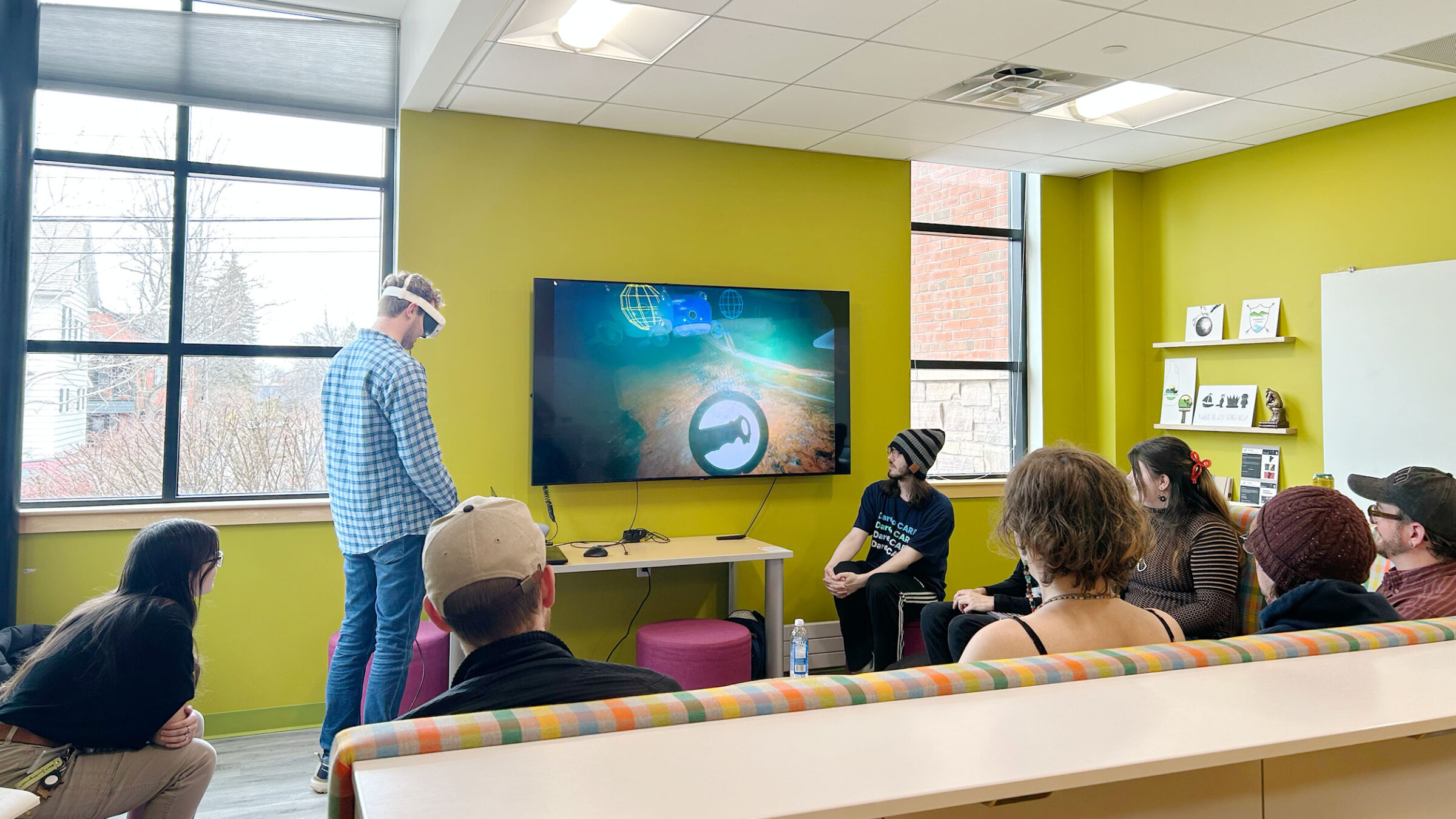
Have you ever wondered what lurks beneath the surface of Lake Champlain? Besides the local legend, Champ, there lies a shipwreck dating back to the Revolutionary War at the bottom — and now you can see it for yourself. How, you may ask? A student-designed interactive virtual reality (VR) exhibit that simulates a dive down to the Spitfire wreck.
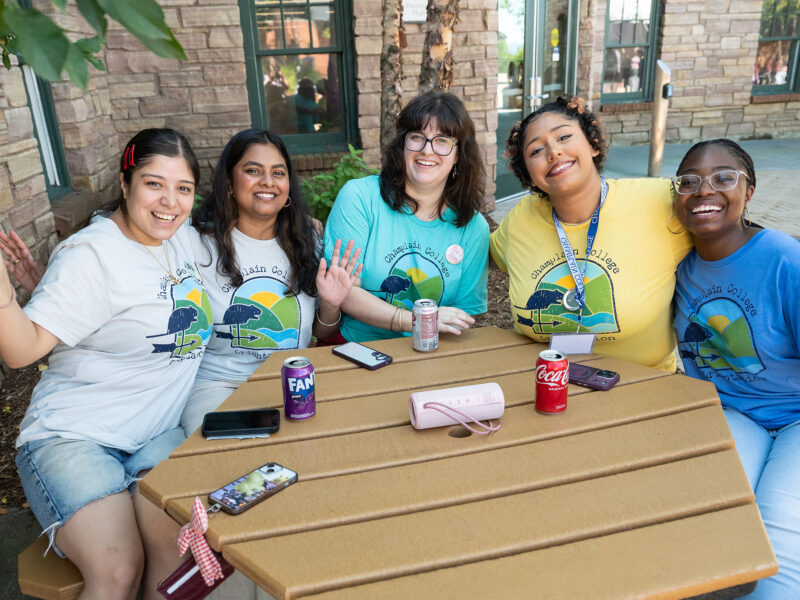
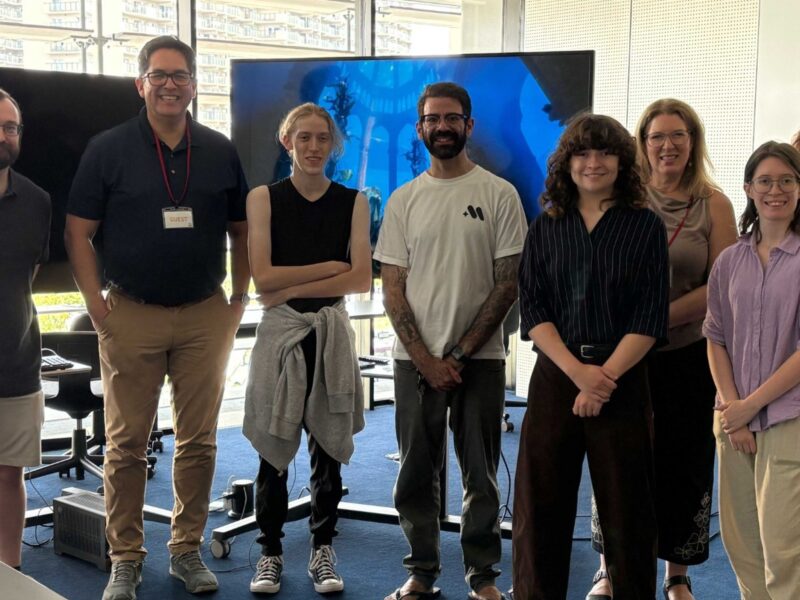
Six students, consisting of Game Design student Madeline Grenier ʼ26; Game Production Management student Olivier Lorin ʼ26; UX/UI Interaction Design student Emma Sipes ʼ27; Game Art student Emaleigh Hunter ʼ26; and Game Programming students Adam Gyenes ’26 and Tommy Krivoruchka ʼ26, enrolled in Professor Rachel Hooper’s Collaborative Project-Based Learning class — and they were required to interview for their positions.
Through the duration of the Spring semester, this team of students was tasked, and paid, to develop an immersive VR exhibit for the Lake Champlain Maritime Museum. The VR game features the Spitfire, a gunboat that is currently sitting at the bottom of the lake. The goal was to create an interactive and accessible exhibit for museum visitors that was both educational and engaging. On May 27, the permanent exhibit opened to the public.
Live From the Maritime Museum!
What Can Everyone Expect to ‘Sea’?
In order to get a visual of the shipwreck, the museum utilized a remotely operated vehicle (ROV) in order to take pictures and swim where people might not be able to go. The students decided an ROV named Fifi would be the narrator for the game, guiding users through the experience.
“One of the things that makes our exhibit unique is that it’s one of the few digital interactives. It’s more immersive than others, where people are actually able to see the sunken ship on the floor and how it’s changed over time,” said Olivier Lorin.
Patricia Reid, Director of Collections at the Maritime Museum, noted the intentional focus on new types of exhibit material. “The previous exhibit was very text heavy, and really was accessible only to folks who were interested in spending a long time reading detailed signs. It wasn’t really designed for folks who might learn better from visuals or audio, so it was important to us to add interactivity into the new exhibit,” she said.
As they worked throughout the semester, the students had to keep in mind an audience that artists are typically taught to avoid. “One of the hardest audiences to design for is ‘everyone.’ It’s as broad as you can go. One of the really complicated things with that, especially because it’s an educational experience, is balancing accessibility and making sure that the experience is full for everyone and that everyone’s getting the information that they need. And one of the main things that we kind of negotiated with our stakeholders was ‘Do we want this experience to be fun and engaging, or do we want to make sure that all the information is going to get across?’ It’s a balance between making sure that we’re delivering on the educational side while also making sure that people are with us,” said Emma Sipes.
Not only did the visual mechanics of the game have to be accessible, but the amount of information as well. “I know most people aren’t necessarily going to know what a trestle tree, a rig or other things that can be found on a ship, so we have to figure out how to explain those in a way that’s easy to understand, but still keeping it factually correct,” said Grenier.
That’s why, when figuring out how to teach museum visitors within the new exhibit, both students and staff had to think carefully about what people were going to take away from the game. “One very simple takeaway is that Spitfire is a shipwreck. You have to swim down to it, right? Another, more complicated one might be about the zebra mussels on the shipwreck. [The exhibit] should answer questions like, ‘Why are they there?’ ‘Do they grow there naturally, or were they blown onto the site?’ It teaches about invasive species and environmental impacts,” said Reid.
She continued, “We follow these guidelines when we develop any kind of program or any kind of exhibit. So we just applied those to this VR experience. It’s not very different, but I would say it’s enhanced what we can do beyond talking to someone or using props. This is a very different, really immersive experience that folks wouldn’t be able to have otherwise.”
IN THE NEWS
Vermont’s Seven Days recently covered the Spitfire VR exhibit too — reporting that the museum’s executive director, Chris Sabick, described the experience as feeling real, like an actual dive.
Read the full "Seven Days" coverageWhat it Takes to Make an Interactive VR Exhibit
One of the main focuses of the Game Studio Experience at Champlain is preparing students for the work environments they’ll experience in and out of game studios. There are a lot of moving parts, tight deadlines, and responsibilities between departments that make utilizing effective workflows one of the most important skills they can have.
“We’re using the Agile scrum methodology, which is what the game industry uses. But we’re also using the Waterfall methodology, because we have an entire timeline set up of what we need to do. It helped us to get through the iteration process and make sure that we hit every single feature point that we want to by the end of the final product,” said Lorin.
During their process, the students noticed the differences in creating a game for a client versus producing one in their classes.
“There’s a huge portion at the beginning of game courses where we’re just concepting, and we have no idea where the experience is actually going to go. But with this project, we know exactly where it needs to go. We pretty much had all of our features figured out by like, sprint three or so, maybe even earlier,” said Madeline Grenier.
“There’s a lot of information that goes into working with different products. We have to think about copyright infringement issues that we don’t really face in the studio, because it’s educational. Most things are fine if they’re strictly education, so we have to work with the museum staff to think about that stuff,” said Sipes.
“We need to make sure that this is a really polished project by the end of it, whereas for other classes, you could have something that sort of works, but it’s more to show off your skills and what you’ve learned and how you’ve applied them in a unique or clever way,” said Grenier
This is a single semester class. To go from nothing to this product in just a few months is wild and clearly shows all the skills that they’ve gained as students at the school.
What They’ll Swim Away With
“Something I have noticed is that each of the students clearly has a very specific role in the project. There’s somebody that’s in charge of user experience, and there’s somebody that’s in charge of the programming, and there’s a clear leader that’s supposed to be communicating directly with me. They do a great job at working as a team. It’s been an overall positive experience, and clearly the school has taught the students how to interact with a client, and that is a really important life skill. I’m glad the students are learning that, said Reid.
“We’re proving that we can learn. All of these things are totally new frontiers for us, and there have been a lot of challenges, but we’re been able to overcome that and still produce something which is really pretty cool and has pleased our stakeholders,” said Sipes.
“People tend to underestimate the possibilities of what you can do with a major like Game Design or Game Art. In a way, I think having some of these internships just helps people realize the possibilities of their major and how they can play a role in certain positions. Also, having things like this on your resume shows that you can work in other fields creatively and that you’re used to doing work that’s maybe atypical of someone who specifically studies games. You’re able to work on a budget, because certain museums won’t have that chunky PC that everyone expects a gamer to have,” said Emaleigh Hunter.
What projects like this do is give students a way to find their niche, even in markets they have yet to explore. There are tons of unexpected paths that a game major can take.
“Personally, I’ve also always been interested in the idea of ‘serious’ game design or educational game design, which is basically making games or immersive training simulations. Say you want to go into engineering or construction, I would be making a fun way to do that and to learn those protocols, rather than just through paper. I know some of the game industry is heading, to some degree, in that direction as well,” said Grenier.
Reid ultimately praised the hard work and dedication of the students, as they completed a project in such a short amount of time, especially when many of them were thrown into uncharted waters: “This is a single semester class. To go from nothing to this product in just a few months is wild and clearly shows all the skills that they’ve gained as students at the school.”
Ready to Make Your Own?
Check out how you can start building your game development skills today.

Cutting-edge careers begin at Champlain College
Fill out the form for more info about our hands-on approach to education.