Women-founded companies receive only 2% of venture capital funding. On October 7, 2026, Catherine Gray, Executive Producer of the documentary Show Her the Money, came to Champlain College to talk about why that is and how our students can drive change by taking their seat at the table.
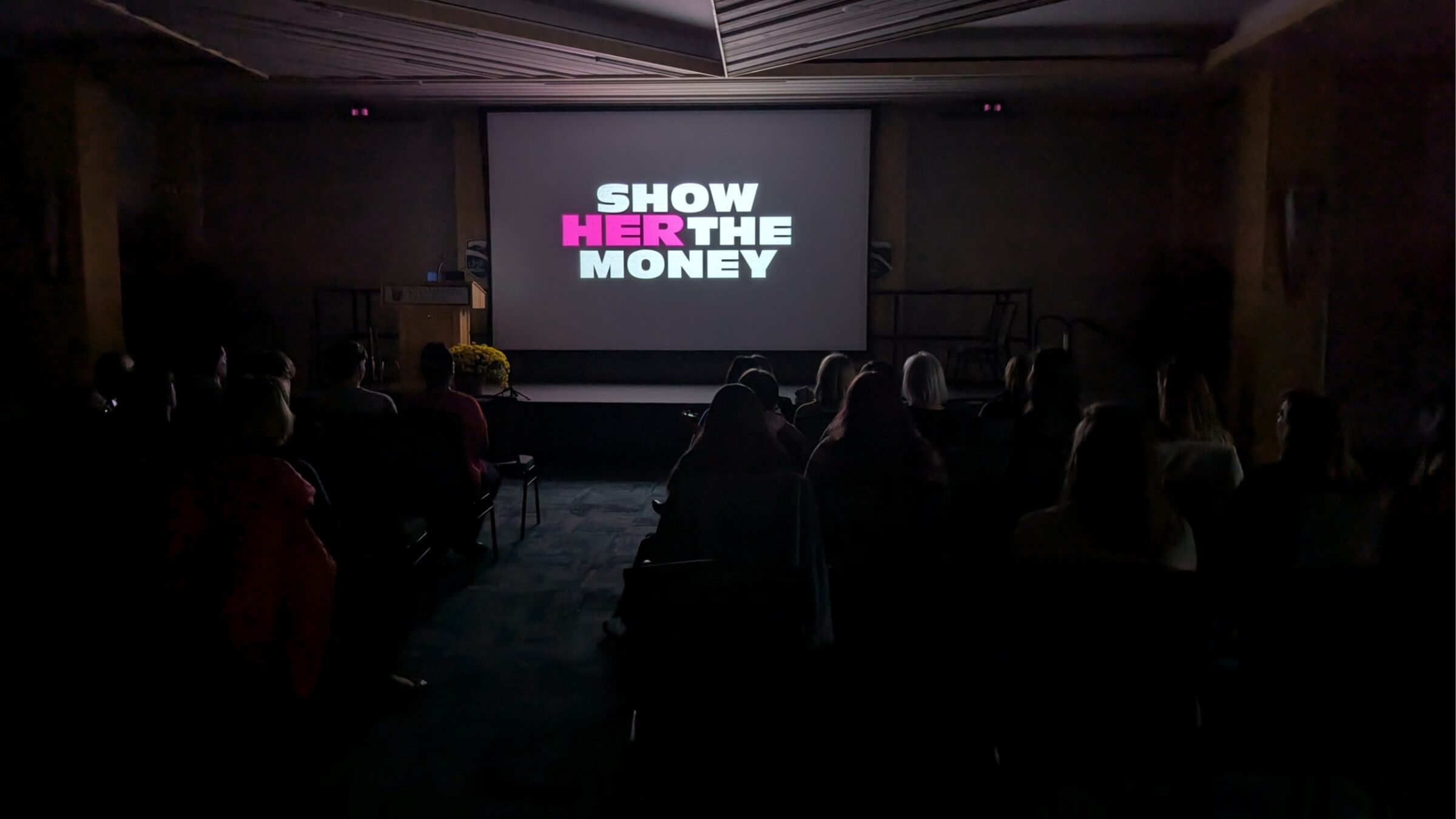
Following a screening of the award-winning film Show Her the Money on its 100-city tour, fourth-year Business Administration student Grace Berry led a conversation with Gray on what it will take to close the gap. With members of Vermont’s entrepreneurship and venture capital communities in the room, the evening reflected Champlain’s commitment to connecting students with the people and conversations shaping industries.
The 2% Problem Is an Awareness Problem
For Gray, it all started with a simple question. “I thought, wow, we’re getting 2%. What’s wrong with that picture? And how do we fix it?”
Part of the answer lies in who makes funding decisions. Most venture capital decision-makers are men, who are statistically most likely to back companies led by other men. Gray sees the fix as change on both sides of the table: “We get more women investing in venture capital, and then we get more men investing in women.” Neither shift happens without awareness, though, and Gray found it in short supply. When she mentioned the 2% figure to accomplished professionals, hardly any of them knew about it.
That’s where Show Her the Money comes in. “I’m a big believer that it’s film and television that helps change culture by raising awareness and educating people,” Gray shared. “The purpose of the movie has been and continues to be to take it around the world and educate people so that we can fix it.”
Understanding the Other Side of the Table
While conversations on the topic often focus on the founders seeking the funding, Berry asked Gray about the other side of that equation, the investors who provide the funding: “What inspires you to empower women to be sitting at the table instead of just at the pitching stage?”
For Gray, the answer connects back to the 2% gap. If male investors tend to back male founders, then the most direct way to fund more women is to have more women at the table. That starts with women seeing investing as a space that belongs to them. “We’ve been missing out on this whole sector of investment that we can make a lot of money in, and men have been making a lot of money for a lot of decades,” Gray said. “If they’re not aware of it, they’re not going to invest in it.”
Increasing the number of female investors does more than shift who gets funded. They’re changing how venture capital works.
Women-led funds, Gray explained, are trying to build something better by coaching the founders they invest in rather than simply writing a check. Those founders, in turn, make the most of what they receive. In her view, the more people who understand and take part in venture capital, the better it gets. Making it “more equitable, more democratic, and having more people participating in it is going to make it a better, stronger system.”
Where to Start
For students who don’t have money to invest yet, Gray emphasized that knowledge still carries weight. Understanding where wealth sits and how it can be directed lets them shape conversations long before they write a check of their own. “It’s good to be aware, so you know who to talk to and who to spread the word to,” she said.
When asked what students can do to become “the next changemakers,” Gray started close to campus. She pointed to Hula and local networking groups, and to organizations like the Red Clover Fund, which she called “a great way for [folks] to learn, ‘How do I be a venture capital investor?’”
For a more structured introduction, Gray described Venture Capital 101, a one-day workshop that accompanies the film. It “teaches you about venture as a career path as well as an investment and a funding path.” The program exists because universities including Vanderbilt, Babson, and UCLA screened the documentary and asked for a curriculum to go with it.
Passing the Torch
Throughout the evening, Gray made it clear that she sees the next generation as essential to closing the gap. “We can be a part of making this change,” she told students. “And that’s what’s really exciting.”
Her message was that the 2% figure won’t change on its own. It changes when more people understand how venture capital works, who controls it, and how to get involved, whether as investors, advocates, or professionals in the field. For students, that change starts with them.