The Office of Diversity & Inclusion’s AmeriCorps VISTA Marguerite Leek shares some facts related to Black History Month, along with recommendations for events to attend and what to listen to and read to continue educating ourselves.
When and how did Black History Month originate? In 1926, Carter G. Woodson, a Black historian and author, recognized that despite the fact that Black Americans were deeply integral to the history of the United States, their accomplishments and successes were continuously left out of American history. To help remedy this, Woodson established the Association for the Study of African American Life and History (ASALH) in 1915. The ASALH sought to preserve, research, and share information about Black life and culture. Eleven years later, Woodson launched the first Black History Week, in between Abraham Lincoln and Frederick Douglass’s birthdays in February. In 1976, President Gerald Ford established the first national Black History Month.
Black history is often whitewashed, made to be more “palatable.” Dr. Martin Luther King Jr. is a prime example of this. MLK Jr., a radical civil rights activist, was disliked by a majority of Americans in 1966 (Theoharris). His image as a peaceful protester has been used to argue against riots and Black Lives Matter protests, when in reality, Dr. King believed that “a riot is the language of the unheard.” This brief example is just a starting point. Black history is American history. Celebrating Black history and Black excellence should be a year-long event. As we work toward making this a reality, we recognize that in the past, we have failed our Black community members, students, staff, and faculty. Throughout the month of February and into the rest of the spring semester, there will be ongoing events and programs centered around Black history and anti-racism. They can be found on The View Events under the Cultural Programming topic filter. More events will continue to be added in the coming weeks.
Below is a short list of podcast episodes, music, books, and poems by Black creators. The goal of this list is to celebrate the work of Black creators throughout history. For a more thorough list of educational and anti-racism resources, see this article. By no means are either of these exhaustive lists. We encourage you to spend time reflecting on these works.
Podcasts & Recommended Episodes
- Black Lives Matter and the Climate — How to Save a Planet
- They Don’t Say Our Names Enough — NPR’s Code Switch
- Fear of a Black Woman’s Body — Black History Year
- Louder Than a Riot
- 2 Dope Queens
- H.E.R Space
Poems & Essays
- See the Poetry Foundations list of featured Black poets & poems for more!
- Riot by Gwendolyn Brooks
- Let America Be America Again by Langston Hughes
- The Master’s Tools Will Never Dismantle the Master’s House by Audre Lorde
- Middle Passage by Robert Hayden
- Many Thousands Gone by James Baldwin
- A Clear Presence by Aisha Sabatini Sloan
- The 1619 Project
Music
- A few of the many influential albums by Black artists that have shaped music:
- A Love Supreme by John Coltrane
- To Pimp a Butterfly by Kendrick Lamar
- A Seat at the Table by Solange
- The Miseducation of Lauryn Hill by Lauryn Hill
- Straight Outta Compton by N.W.A
Books
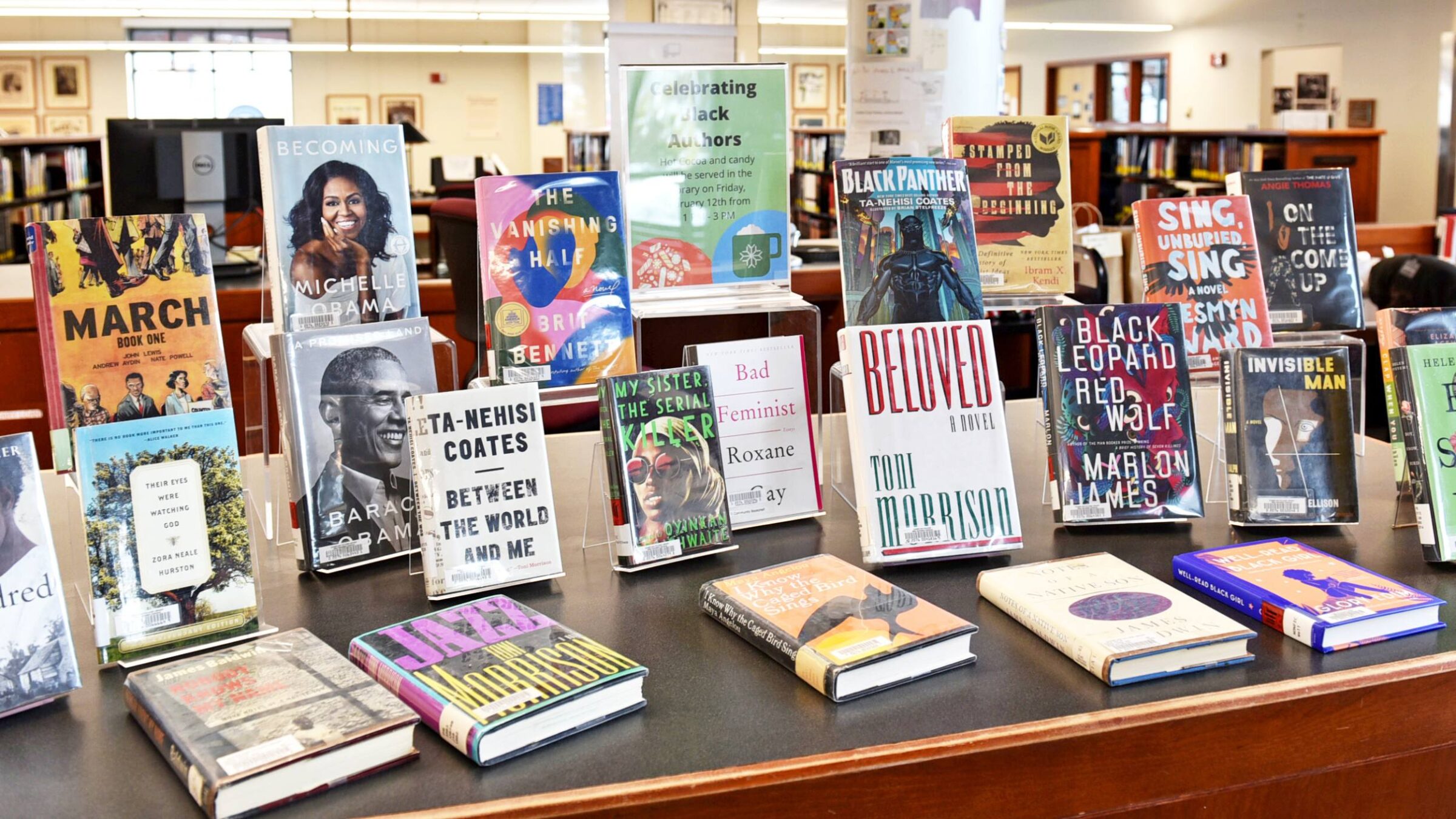
A short list of fiction and nonfiction texts from Black authors are listed below. The Champlain College Library will have a book display (pictured above) celebrating Black authors from February 7—28, where many of these texts will be available to check out.
- Beloved by Toni Morrison
- Their Eyes Were Watching God by Zora Neale Hurston
- Between the World and Me by Ta-Nehisi Coates
- Such a Fun Age by Kiley Reid
- I Know Why the Caged Bird Sings by Maya Angelou
- Grand Union by Zadie Smith
- On the Come Up by Angie Thomas
- Go Tell it on the Mountain by James Baldwin
- Invisible Man by Ralph Ellison
- Ain’t I a Woman: Black Women and Feminism by bell hooks
- The Color Purple by Alice Walker
- Stamped from the Beginning by Ibram X. Kendi
- Bad Feminist by Roxanne Gay
- Just Mercy: A Story of Justice and Redemption by Bryan Stevenson
- The New Jim Crow: Mass Incarceration in the Age of Colorblindness by Michelle Alexander
Author